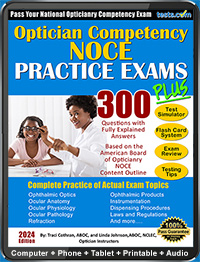
2024 Edition
Optician Tests Guide
| Optician Tests Summary
|
|
|---|---|
| What: Professional certification exams for opticians | |
| Who: Opticians and ophthalmic dispensers can take the exams | |
| Where: Exams are given at Prometric centers across the country. | |
| When: Exams are offered monthly. | |
| How: Multiple choice | |
| Type: Computer | |
| Why: Professional certification can help one advance a career. | |
| Time: Two hours | |
| Language: English | |
| Preparation: Study guides and other preparation materials are available for purchase. | |
| Cost: Each exam charges a fee. | |
Opticians, or those who work with the fitting and dispensation of eye glasses, and ophthalmic dispensers, or those who work with contact lenses, can earn voluntary professional certification. Professional certification is earned through an exam, and such a professional designation can help an optician demonstrate their knowledge, skills and dedication to the career field. While certification is voluntary, many employers require their opticians and ophthalmic dispensers to be certified prior to being hired.
Certification exams for opticians are offered by the American Board of Opticianry (ABO), while certification exams for ophthalmic dispensers are offered by the National Contact Lens Examiners (NCLE). Both organizations are non-profit certifying bodies whose programs are certified by the National Commission for Certifying Agencies. Each organization has developed a set of standards that opticians and ophthalmic dispensers must meet in order to earn initial certification. In addition, both organizations have requirements for continuing education as part of the recertification process. The ABO exam is called the National Opticianry Competency Exam (NOCE). The NCLE exam is called the Contact Lens Registry Examination (CLRE).
Each exam includes 125 multiple-choice questions and two hours is given for exam completion.
The NOCE exam is broken down as follows:
- Domain I - Ophthamalic Optics
- Domain II - Ocular Anatomy, Physiology, Pathology and Refraction
- Domain III - Ophthamalic Products
- Domain IV - Instrumentation
- Domain V - Dispensing Procedures
- Domain VI - Laws, Regulations and Standards
The CLRE exam is broken down as follows:
- Domain I - Ocular Anatomy, Physiology and Pathology
- Domain II - Refractive Errors
- Domain III - Instrumentation for Measurement and Observation
- Domain IV - Prefitting
- Domain V - Diagnostic Fitting
- Domain VI - Dispensing
Exam eligibility requirements include having a high school diploma or GED and being at least 18 years old. Though not required, having at least two years of professional experience in optometry is recommended, as test candidates with experience generally earn higher scores.
There is a registration fee for each exam. Exams are offered twice yearly, both in May and in November. Testing sites are located throughout the country; during registration, candidates are asked to locate a city with a testing center on a provided list, and subsequently will be registered at that location. Registration packets are available online.
Certification must be renewed every three years. To renew certification, one must earn 12-21 continuing education credits and pay a renewal fee. Additionally, following initial certification and several years of professional experience, candidates may be eligible for advanced certification. The ABOC-AC and NCLE-AC exams each bear a fee of $150 and are offered four times yearly at select locations in the United States.
Both advanced exams include content areas similar to the initial ABO and NCLE exams, along with questions that cover human resources, marketing, business management, customer service and professional development.
Once a candidate has passed a certification exam, the ABO or NCLE will mail the candidate a certificate announcing their new credential.
To learn more about certification exams for opticians and ophthalmic dispensers, or to find exam study materials, please visit the Optician Test Directory.