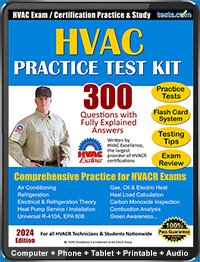
2024 Edition
HVAC Practice Test
HVAC practice exams can be used for professional-growth and to prepare for certification exams. Our HVACR practice exam consists of questions developed by HVAC Excellence, the largest provider of certifications (more than 200,000) in the HVACR industry.
Our 300 question HVAC practice test provides:
- assessment of broad based HVACR knowledge
- practice in the various core specialty areas
- benefit for self-assessment and professional-growth, as well as for exam preparation
- use for students in trade-schools studying for course exams and for professional technicians sitting for certification exams
- a good opportunity for practicing test taking skills and learning the subject matter
A 100 question EPA 608 practice test comes with our materials.
Take this free HVAC practice test to see how prepared you are for an HVAC certification exam.
Quality starts with who wrote the material.
Our practice exam writer
s
:
Written by:
HVAC Excellence
HVAC Excellence
The questions are based on industry standards and offer a comprehensive coverage of the fundamental subject matter found on most HVACR certification exams.
The HVACR Practice Test Kit provides:
- assessment of broad based HVACR knowledge
- practice in the various specialty areas
- a good opportunity for practicing test taking skills and learning the subject matter
Summary of Typical HVACR Certification Exams:
What: HVACR exams are part of the certification process for HVACR technicians which identifies the scope and level of a technician's competency in core and specialty areas.
Who: HVACR professionals who wish to become certified in various HVACR specialties
Where: HVACR certification exams are typically administered at various testing centers, schools and other locations throughout the United States.
When: There are various times throughout the year so check with the exam provider for information.
Why: Certification programs improve technical competency and safety allowing technicians to demonstrate competency and earn more money.
Type: Multiple choice, in both computer-based and paper/pencil formats.
Time: Time varies. The average time is 2 hours.
Language: English
Cost: Depending on the subject and organization, it typically costs between $25 - $150 per actual certification exam.