Master Electrician Exam FAQs
The Master Electrician Exam is used to determine whether a journeyman electrician has the requisite knowledge and skill that is necessary to become a licensed master electrician. It is a specialty certification exam administered by each state's regulating body and is used to determine whether an individual has the requisite knowledge and skills necessary to become a licensed general electrician.
The Master Electrician Exam will generally consist of multiple-choice questions.
The number of questions on the Master Electrician Exam vary from state to state but the average is 80 to 100 questions.
The time limit for the test varies from state to state but the average time is four to five hours.
Where the Master Electrician Exam is taken will vary from state to state but many states use test providers such as PSI/AMP test center locations or Pearson Vue testing centers in the United States. The tests may be available in both computer and pencil and paper formats. Candidates may register online.
The passing score for the Master Electrician Exam varies from state to state.
The exams differ in format and content from state to state, but they tend to cover similar material and are designed to assess an applicant's knowledge of basic electrical theory and the electric code. In general, a journeyman electrician is expected to have a basic understanding of low voltage systems and wiring in residential, commercial and other settings. The Master Electrician Exam typically covers the following domains:
- Electrical definitions
- Electrical service and equipment
- Electrical feeders
- Branch circuit conductors
- Electrical wiring methods
- Electrical materials
- Motors and generators
- Electrical control devices and disconnecting means
- Special occupancies
- Renewable energy technologies
Some jurisdictions involve a business and law examination as part of the master electrician exam. The business and law exam consists of multiple choice questions covering such subjects in business management, accounting and federal and state laws related to the electrician's trade.
The Master Electrician Exam is typically developed by each state's Electrical Contractor's Licensing Board. Local building departments administer the electrician's licensing exam.
To sign up to take the test, contact your local government agency overseeing electricians. Ask the agency for a blue print of the exam, which will provide information about the number and type of questions on the exam and how much time you will have to complete the exam. The blue print may also inform you of what score is needed to pass the exam. Exams typically have open and closed book portions and allow the use of the National Electrical Code Book where indicated. Some jurisdictions allow the use of tabbed NEC books. Once you qualify to take the test and sign up for it, the local building department will inform you where and when the test will be conducted.
The Master Electrician Exam may be offerred at specified time periods during the course of the year and, in some jurisdictions, it may be offered on a daily basis, year-round. Contact your local government agency overseeing electrician licensing to find out when the test is given.
The Master Electrician Exam is used to determine whether an individual has the requisite knowledge and skills necessary to become a licensed general electrician. The exams differ in format and content from state to state, but they tend to cover similar material and are designed to assess an applicant's knowledge of basic electrical theory and the electric code. In general, a journeyman electrician is expected to have a basic understanding of low voltage systems and wiring in residential, commercial and other settings.
To qualify to take the master exam, an individual typically has to have two years of experience as a journeyman electrician. However, some states may not require the applicant to have a journeyman license. If you have enough time in the field to take the master exam, you may be permitted to bypass the journeyman exam in some jurisdictions. Most states that require electricians to be licensed also require that they hold a high school diploma or GED, and complete a 3-5 year apprenticeship program with a master or journeyman electrician before they are able to take the licensing exam. Some employers and unions require electricians to also have an associate degree.
An electrician's work is highly regulated by the individual states in order to serve public safety. As a matter of regulation, electricians must be licensed in most states. In many states, a license is only obtainable after passing an exam.
You will receive it by mail or email within one to two weeks after you take the Master Electrician Exam.
If you are a journeyman or master electrician and seek to move to another state, check to see if the destination state will require you to retest to work as a journeyman or master electrician in that state. Some states will honor a license granted in another state and it typically depends on what company administered the test and what score was achieved.
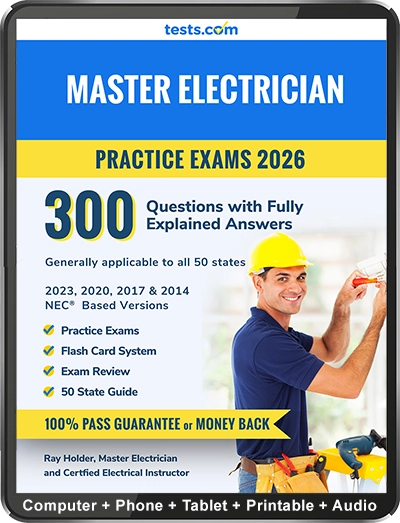
Practice tests, such as Tests.com's Master Electrician Practice Exam, are a good way to study as it goes over the material you need to know while giving you a chance to practice your test taking skills. Additionally, study guides, text books, class notes, flashcards and videos are important study tools. It is best to use a wide range of test prep to get the most comprehensive coverage of the subject matter.
Tests.com has worked with electrician instructors to create a Master Electrician Practice Test to help you prepare for the exam. Tests.com's TestSim online interactive platform allows you to tailor tests to the subjects you want to study and to form tests to fit your study schedule. You can even simulate the actual Master Electrician Exam by setting the number of questions and timer to the time period allowed for the actual test. Click here for a free Master Electrician Practice Exam.