Respiratory Therapist Exam FAQs
The Therapist Multiple-Choice (TMC) exam for Respiratory Therapy is the certification test for all respiratory therapists (RTs) in the United States. It is developed and maintained by the National Board for Respiratory Care (NBRC). The exam measures a candidate's competency to become an entry-level Respiratory Therapist (RT).
An RRT is a Registered Respiratory Therapist. Currently, there are two levels of respiratory therapy practice: the Certified Respiratory Therapist (CRT) and the Registered Respiratory Therapist (RRT). CRTs need to complete, at minimum, a two-year associate's degree or baccalaureate. After the program, they are eligible to take the Therapist Multiple-Choice (TMC) exam for respiratory therapy. RRTs need to complete, at minimum, a two-year associate's degree or baccalaureate. After the program, they are eligible to take the multiple-choice credentialing exam for respiratory therapy obtaining a minimum score which is determined by the NRBC. After passing the multiple-choice credentialing exam, he/she is then eligible for the clinical simulation examination. Achieving a passing score on the clinical simulation examination leads to the credential of a Registered Respiratory Therapist (RRT).
Yes, the CRT and/or RRT credentials are used as the basis for licensure in all 49 states that regulate the practice of respiratory care. State licensure is mandatory for all respiratory therapists practicing in the United States except Alaska.
The TMC consists of multiple choice questions. There are four general types of questions to expect on the exam. You will have 3 questions on ethics, 33 questions will be in a recall format, 66 questions will be application-style questions, and 41 questions will be on the analysis of information. Pediatric patient questions range from a minimum of 3 questions to a maximum of 8. Neonatal questions can also range from a minimum of 2 to a maximum of 5 questions.
There are 160 questions on the TMC exam, with only 140 scored. 20 questions are randomized and don't count toward the score as they are questions that are currently being evaluated for future tests. These 20 questions are randomized and are not noted as such, so you will not know which of the exam questions do not count toward your score.
The TMC exam is timed, and you will have 180 minutes to complete the exam so you will have just over one minute per question.
NBRC's testing agency, PSI, assists in the administration, scoring and analysis of the credentialing examinations. PSI has test centers in every US state and territory.
Each item is worth one point, so the sum of correct responses is a raw score. Your total score determines whether you pass or fail the examination after a comparison to the cut score. The cut score for a multiple-choice type of examination is determined by the examination committee. The comparison of your score to the cut score will determine whether you pass or fail. RRTs need to complete, at minimum, a two-year associate's degree or baccalaureate. After the program, they are eligible to take the multiple-choice credentialing exam for respiratory therapy. After passing the multiple-choice credentialing exam with a certain score (determined by the NBRC), he/she is then eligible for the clinical simulation examination. Achieving a passing score on the clinical simulation examination leads to the credential of a Registered Respiratory Therapist (RRT).
The TMC covers the following domains:
- Patient Data
- Equipment Manipulation, Quality Control and Infection Control
- Initiation and Modification of Therapeutic Procedures
The National Physical Therapy Examination (TMC) was developed and maintained by the National Board for Respiratory Care (NBRC). The exam measures a candidate's competency to become an entry-level Respiratory Therapist (RT).
The TMC is offered year-round at PSI testing centers.
The Certified Respiratory Therapist Exam (CRT) is an exam for entry-level respiratory therapists. Successful performance on the exam leads to the CRT designation, which is a voluntary certification credential. Certification can be used by respiratory therapists to demonstrate to current and future employers their dedication to their career as well as a high level of competency in respiratory therapy.
In order to take the TMC, you must meet the following eligibility requirements:
- Must be 18 years old and
- Either have an associate degree in respiratory therapy from an accredited institution or be enrolled in an accredited bachelor's degree program in respiratory therapy. Candidates meeting the latter requirement will need to provide a certificate of completion from their college or university that indicates the successful completion of coursework in advanced science and respiratory therapy classes.
NBRC's testing agency, PSI, assists in the administration, scoring and analysis of the credentialing examinations. PSI has test centers in every US state and territory. See www.test-takers.psiexams.com for exact testing dates and locations.
Candidates can attempt the TMC and Clinical Simulation Examinations three times, after which the candidate will be required to wait a minimum of 120 days between any subsequent attempt.
After you have completed the TMC, your score report will be sent by email to the address on file with PSI.
Each state has unique licensing and continuing education requirements for physical therapists. See your state and local jurisdiction board website for more information on license and continuing education requirements. Maintaining a credential is separate from maintaining a license. Continuing education credits (CE) may be required depending on your assessment performance. If your assessment score is high enough, no CEs will be required to renew your credential(s). You might be exempt from CE requirements for the NBRC however, the state in which you live is likely to require CE documentation for your license.
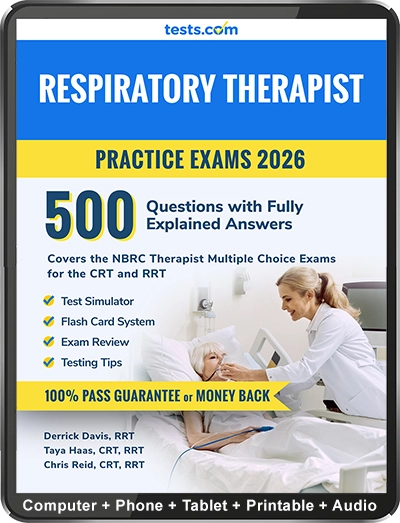
Practice tests, such as Tests.com's Respiratory Therapist Practice Exam, are a good way to study as it goes over the material you need to know while giving you a chance to practice your test taking skills. Additionally, study guides, text books, class notes, flashcards and videos are important study tools. It is best to use a wide range of test prep to get the most comprehensive coverage of the subject matter.
Tests.com has worked with instructors in respiratory therapy to create a Respiratory Therapist Practice Test to help you prepare for the TMC exam. Tests.com's TestSim online interactive platform allows you to tailor tests to the subjects you want to study and to form tests to fit your study schedule. You can even simulate the actual TMC exam by setting the number of questions and timer to the time period allowed for the actual test. Get experience reading multiple-choice questions and taking timed tests. Tests.com will help you pass your TMC exam on your way to a successful career as a respiratory therapist. Click here to take a free Respiratory Therapist Practice Exam.