Medical Coding Exam FAQs
The Certified Professional Coder (CPC) credential is one of the highest standards for medical coding. The CPC certification exam tests the competencies required to perform the job of a professional medical coder in services performed by physicians, nurse practitioners and physician assistants. Individuals who earn the CPC credential have proven expertise in provider documentation review, abstract professional provider encounters, among others.
The American Association of Professional Coders is the certifying body of the field and administers the registry examination to all medical coder candidates. The AAPC also determines the content specifications for the certification examination, as well as the competency requirements for all candidates.
There is no general state requirement for licensure medical coders in the United States. However, medical coders looking for work may find it difficult without a professional credential. Employers typically look to hire those who have taken the step to obtain a professional credential.
The CPC exam consists of multiple choice, some of which are scenario based questions. Questions are displayed one at a time. You can flag questions that you are unsure about, so you can come back to them prior to submitting the exam.
The CPC exam is a computer-based test that is comprised of 100 multiple-choice questions.
The actual exam is timed, and you have four hours to finish the exam after you begin.
Once a test candidate's application has been approved, the candidate will be provided instructions on scheduling their exam. Exams are offered at local chapters or licensed instructor sites around the country or online.
You must answer 70% of the questions correctly on the CPC to pass.
The CPC exam covers the following domains:
- Integumentary System
- Musculoskeletal System
- Respiratory and Cardiovascular System
- Digestive System
- Urinary and Reproductive Systems
- Nervous System
- E/M Services
- Anesthesia
- Radiology
- Pathology and Laboratory
- Medicine
- Anatomy and Medical Terminology
- ICD-10-CM/Diagnosis and HCPCS Level II
- Miscellaneous Scenarios - Operative, Progress and Procedure Notes
- Clinical Classification System
- Reimbursement Methodologies
- Health Records and Data Content
- Compliance
- Information Technologies
- Confidentiality and Privacy
The American Association of Professional Coders is the certifying body of the field and administers the registry examination to all medical assistant candidates. The AAPC also determines the content specifications for the certification examination, as well as the competency requirements for all candidates.
The CPC is offered on a daily basis, year-round at testing sites across the United States and US territories. Tests can be scheduled any day of the week, year round.
The Certified Professional Coder (CPC) credential is a professional marker of distinction, one that demonstrates to employers and colleagues that a medical assistant adheres to a stringent set of professional medical assistant standards. Except for some specialty areas of practice, there is no general state requirement for licensure for medical assistants in the United States. However, medical assistants looking for work may find it difficult without a professional credential. Employers typically look to hire those who have taken the step to obtain a professional credential.
A high-level knowledge of medical terminology, anatomy, and pathophysiology, along with understanding of the proper application of CPT® procedure codes, HCPCS Level II procedure and supply codes, and ICD-10-CM diagnosis codes. Or, a prerequisites course through the AAPC to prepare you for the CPC.
All candidates register to test through AAPC wbsite.
Candidates who do not pass the exam can reapply to take the CPC exam.
Exam results will be available within 7-10 business days of completing the CPC Exam. Results will show in the member area under MyAAPC>Exams in the exam details.
AAPC requires that you perform continuing education (36 CEU credits) to maintain your credential every two years.
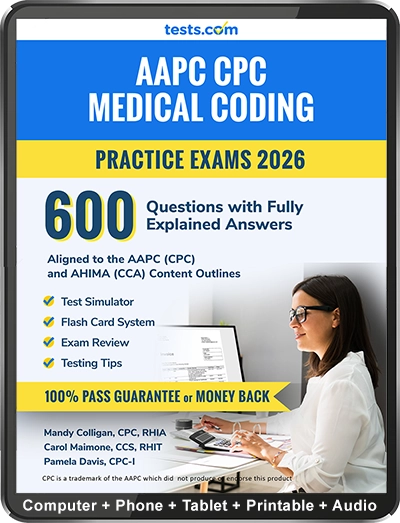
Practice tests, such as Tests.com's Medical Coder Practice Exam, are a good way to study as it goes over the material you need to know while giving you a chance to practice your test taking skills. Additionally, study guides, text books, class notes, flashcards and videos are important study tools. It is best to use a wide range of test prep to get the most comprehensive coverage of the subject matter.
Tests.com has worked with instructors in the medical coding field to create a CPC Practice Test to help you prepare for the CPC exam. Tests.com's TestSim online interactive platform allows you to tailor tests to the subjects you want to study and to form tests to fit your study schedule. You can even simulate the actual CPC exam by setting the number of questions and timer to the time period allowed for the actual test. Get experience reading multiple-choice questions and taking timed tests. Tests.com will help you pass your CPC exam on your way to a successful career as a Certified Professional Coder. Click here for a free Medical Coder Practice Exam.