NBDHE FAQs
The National Board Dental Hygiene Examination (NBDHE) assesses each candidate's ability and knowledge of basic biomedical and dental hygiene sciences and how it applies to real life situations. The NBDHE assists state dental boards in evaluating qualifications of dental hygienists for licensure. Success on the National Board Dental Hygiene Exam is a requirement to practice dental hygiene in the United States. The exam tests students on their understanding of dental, biomedical, and dental hygiene sciences and assesses their ability to apply this information in a problem-solving context. Students may take the NBDHE no sooner than four months before they are to receive a dental hygiene diploma and must obtain certification of approval for testing from the director of their program.
Licensing to practice dental hygiene is regulated by individual states and typically administered by State Boards of Dentistry. All states require at least three minimum qualifications: successful completion of a dental hygiene program, a written exam, and a clinical exam. Before applying to take the NBDHE, students must confirm that they have read the National Board Dental Hygiene Exam Guide, published by the Joint Commission on National Dental Examinations (JCNDE).
The NBDHE consists of Multiple Choice, Paired True-False, Cause-Effect, Matching, Ordering, Multiple Response, Item Sets, Testlets, and Item Shells questions. The exam is administered in a computer-adaptive format, which means that each question is chosen based on the answer given to the previous question. The test continues until a pass or fail determination can be made.
The NBDHE consists of 350 multiple-choice items covering functions that dental hygienists perform. Functions dental hygienists perform in a majority of states are included in the examination.
Administering the NBDHE takes approximately 9 hours, including an optional hour-long lunch break. Candidates must report to their testing centers 30 minutes before the exam starts and complete a 15-minute exam tutorial. Candidates will then be given three and a half hours to complete 200 discipline-based items. This first session will cover many skills, including use of preventive agents, assessing patient characteristics, and interpreting radiographs. After the hour-long optional lunch break, a second four-hour long session will contain 150 patient-case items. Items on the exam will cover topics that dental hygienists must know to perform their duties and the American Dental Association Universal/National tooth notation system will be used. A 15-minute post-survey will follow the examination.
All candidates register to test through NBDHE website. Candidates may test through Pearson VUE, the national testing vendor for the NBDHE. Pearson VUE has test centers in every US state and territory.
Each NBDHE edition has its own unique grading scale based upon the national average. To pass the exam, candidates must receive a score that is higher than the standard score. There is no penalty for selecting incorrect answers. Scale scores range from 49 to 99, with 75 representing the minimum passing score. Scale scores are not raw scores (i.e., the number of questions answered correctly).
The NBDHE GC covers the following domains:
- Scientific Basis for Dental Hygiene Practice (56 items)
- Provision of Clinical Dental Hygiene Services (124 items)
- Community Health/Research Principles (20 Items)
- Case Based Items (150 items involving 12 to 15 dental hygiene patient cases)
The NBDHE exam was developed by subject matter experts using the above exam outline. The experts are appointed based on their expertise in six areas:
- biomedical sciences
- radiology
- periodontics
- dental hygiene curriculum
- clinical dental hygiene
- community dental health
The NBDHE is offered on a daily basis, year-round at testing sites across the United States and US territories. Tests can be scheduled any day of the week, year round. Pearson VUE has test centers in every US state and territory.
Success on the National Board Dental Hygiene Exam is a requirement to practice dental hygiene in the United States. The exam tests students on their understanding of dental, biomedical, and dental hygiene sciences and assesses their ability to apply this information in a problem-solving context. Licensing to practice dental hygiene is regulated by individual states and typically administered by State Boards of Dentistry. All states require at least three minimum qualifications: successful completion of a dental hygiene program, a written exam, and a clinical exam.
Licensing to practice dental hygiene is regulated by individual states and typically administered by State Boards of Dentistry. All states require at least three minimum qualifications: successful completion of a dental hygiene program, a written exam, and a clinical exam. Before applying to take the NBDHE, students must confirm that they have read the National Board Dental Hygiene Exam Guide, published by the Joint Commission on National Dental Examinations (JCNDE). This guide and the application form can be found at www.ada.org. A non-refundable fee of $265 dollars must be paid when applying for the NBDHE.
All candidates register to test through NBDHE website. Candidates may test through Pearson VUE, the national testing vendor for the NBDHE. Pearson VUE has test centers in every US state and territory.
Retaking the NBDHE is permitted, but may not occur within 90 days of the last exam administration. Candidates who receive a passing score on the NBDHE will not be permitted to retake the exam unless required to by a state or regulatory agency. Candidates who have failed the exam three times will be required to wait 12 months before retaking it.
Examination results are typically available approximately three to four weeks after you take the NBDHE. Results can be viewed online.
Licensing to practice dental hygiene is regulated by individual states and typically administered by State Boards of Dentistry. Each state has its own requirements to renew a license.
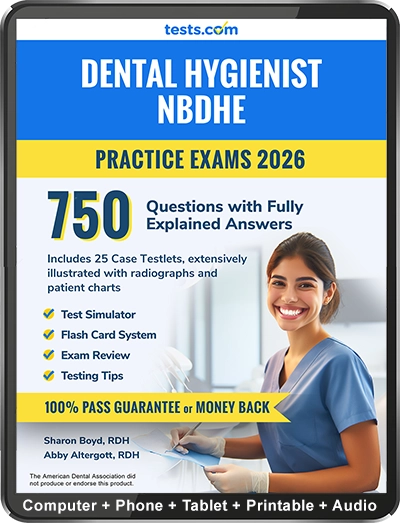
Practice tests, such as Tests.com's NBDHE Practice Exam, are a good way to study as it goes over the material you need to know while giving you a chance to practice your test taking skills. Additionally, study guides, text books, class notes, flashcards and videos are important study tools. It is best to use a wide range of test prep to get the most comprehensive coverage of the subject matter.
Tests.com has worked with instructors in dental hygiene to create a NBDHE Practice Test to help you prepare for the NBDHE. Tests.com's TestSim online interactive platform allows you to tailor tests to the subjects you want to study and to form tests to fit your study schedule. You can even simulate the actual NBDHE exam by setting the number of questions and timer to the time period allowed for the actual test. Get experience reading multiple-choice questions and taking timed tests. Tests.com will help you pass your NBDHE on your way to a successful career as a dental hygienist. Click here to take a free NBDHE practice test.